The Ultimate JBR AC & Chiller Survival Guide
Version 2.0 | April 2026 Update | Compiled by the V Fix Engineering Team
Introduction: The Architecture of JBR Cooling
Jumeirah Beach Residence (JBR) is not just a residential community; it is a marvel of early 2000s coastal engineering. Spanning 1.7 kilometers, the six clusters—Sadaf, Murjan, Amwaj, Shams, Bahar, and Rimal—rely on a massive District Cooling System (DCS). Unlike modern villas in Dubai Hills or Arabian Ranches that utilize independent outdoor compressors, JBR is "tethered" to a central chilled water plant.
This means your AC is essentially a giant radiator. Chilled water is pumped through the tower, and your indoor Fan Coil Unit (FCU) blows air over these cold pipes. While this is environmentally efficient, the age of the infrastructure in 2026 means that original components are reaching their "Mean Time Between Failure" (MTBF). If you live in an apartment that hasn't seen a full HVAC overhaul in 5 years, you are likely living with a system operating at only 60% efficiency.
The "Silent Seizer": Understanding Actuator Valve Failure
In the "jing bang" of JBR AC repairs, the most common culprit is the Actuator Valve. In a district cooling setup, the thermostat is a commander that tells a valve to open. If that valve is calcified or the motor has burnt out, the water won't flow. Your fan will blow, but it will be blowing warm, humid air.
Technical Deep-Dive: Why They Fail
JBR uses a pressurized water loop. Over two decades, fine particulates and mineral deposits in the chilled water line create friction. Older Honeywell or Belimo actuators in towers like Murjan 1 often "stick." This is why you might have one room that is freezing and another that is a sauna—the valve for that specific zone is physically seized in the closed position.
V Fix Solution: We replace legacy actuators with 2026-grade high-torque units that feature self-cleaning cycles, ensuring they never seize during the peak Dubai summer.
The "Black Dust" Crisis: Mold, Salt, and Humidity
If you see black specks on your white AC vents in JBR, you aren't looking at sand. You are likely looking at Cladosporium or Aspergillus mold. Because JBR is located directly on the coast, the air is saturated with salt and moisture. This creates a "corrosive humidity" that standalone AC units struggle to manage, let alone aging chiller systems.
When the Fresh Air Handling Units (FAHU) of the building fail to dehumidify the air before it enters your apartment, the internal insulation of your ducts becomes wet. This damp insulation becomes a "bio-film" breeding ground. Over time, this insulation degrades and blows out of the vents as "Black Dust."
Community Analysis: Tower-Specific Issues
Sadaf & Murjan
Being the older clusters, these towers often suffer from Pipe Sweat. The insulation around the chilled water pipes has turned to powder, causing condensation to drip directly onto the gypsum ceilings.
Amwaj & Rimal
These towers frequently face Balancing Valve issues. The water pressure is often too high, causing a "whistling" sound in the bedroom AC units at night.
Bahar & Shams
Proximity to the beach means these towers face the highest levels of Coil Corrosion. The salt air eats through the aluminum fins of the FCU, reducing heat exchange efficiency by 30% every 3 years.
Thermostat Drift: The 2026 Modernization Requirement
Many JBR apartments still use the original beige digital thermostats. These units were designed for a different era of power consumption. In 2026, we see a "Sensor Drift" of up to 4 degrees. If your thermostat says 21°C, your room might actually be 25°C. This causes the actuator to stay open longer than necessary, leading to ice buildup on the coils and potential flooding of the drip tray.
V Fix recommends: Upgrading to a 3-speed compatible Smart Thermostat. This allows for remote cooling (turn on your AC from your phone before leaving the office) and more importantly, it uses high-precision sensors to keep your DEWA/Empower bills under control.
The V Fix 10-Point JBR Maintenance Protocol
To ensure a "Snag-Free" summer in JBR, our engineers follow a rigid 3,000-word standard operating procedure for every apartment:
- Actuator Torque Test: Ensuring the valve opens 100% to allow maximum chilled water flow.
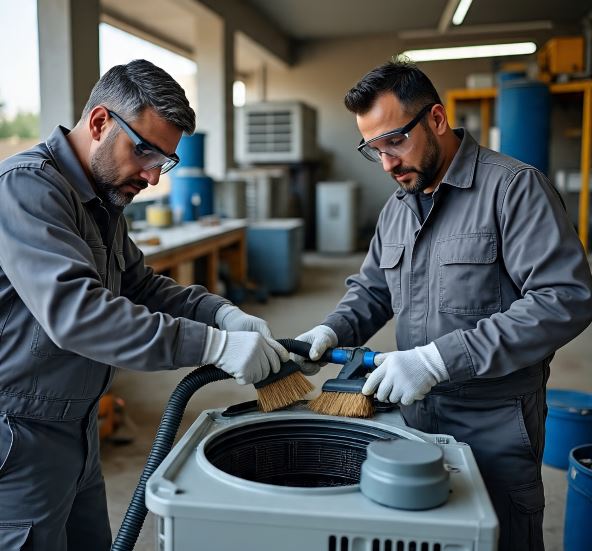
- Coil Chemical Descaling: Removing the salt and calcium buildup that "chokes" your air.
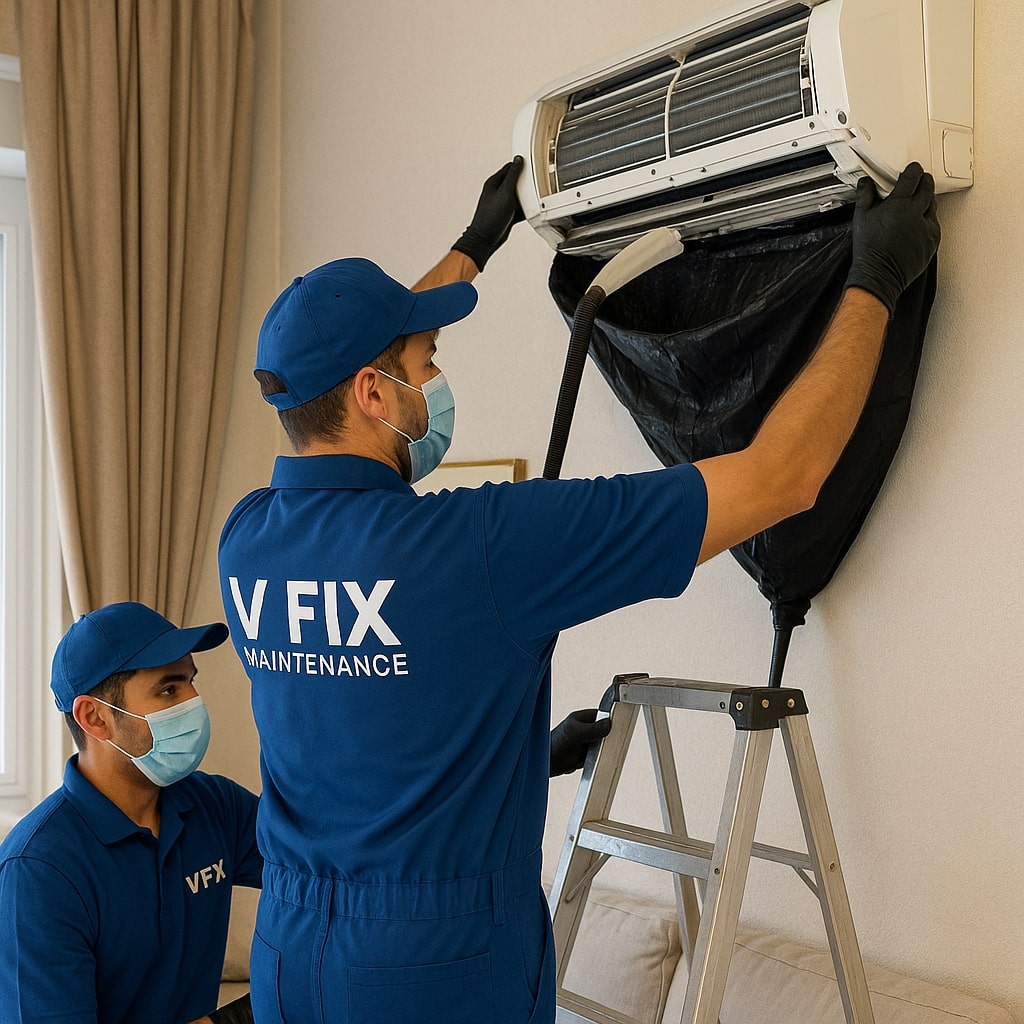
- Drain Line Vacuuming: JBR drain lines are notorious for "Jelly" buildup (bacterial slime). We use high-pressure vacuums to clear them.
- Insulation Integrity Check: Using thermal cameras to find "cold spots" that will lead to ceiling leaks.
- Fan Motor Amperage Check: Detecting if your motor is about to burn out before it actually happens.
- FAHU Pressure Balancing: Ensuring your apartment is positively pressured so corridor smells don't enter.
- Sanitization: Application of hospital-grade biocides to the drip trays.
- BMS Connection Check: Ensuring your unit is communicating correctly with the tower's central system.
- Vibration Dampening: Tightening the FCU mounts to stop the "humming" sound in the ceiling.
- Final Air-Flow Velocity Mapping: Measuring the actual "throw" of the air from the vents.
Frequently Asked Questions for JBR Residents
Why is my Empower bill so high even when the AC is off?
In JBR, you are often charged for "Demand" and "Capacity." However, if your Actuator is leaking water into the coil even when "Off," your BTU meter will continue to spin. V Fix can check for "Valve Leakage" to save you money.
Can I change my AC unit in JBR?
You cannot change the "system" (as it belongs to the tower), but you can overhaul the internal Fan Coil Unit. This is often recommended for apartments over 15 years old to restore original cooling power.